
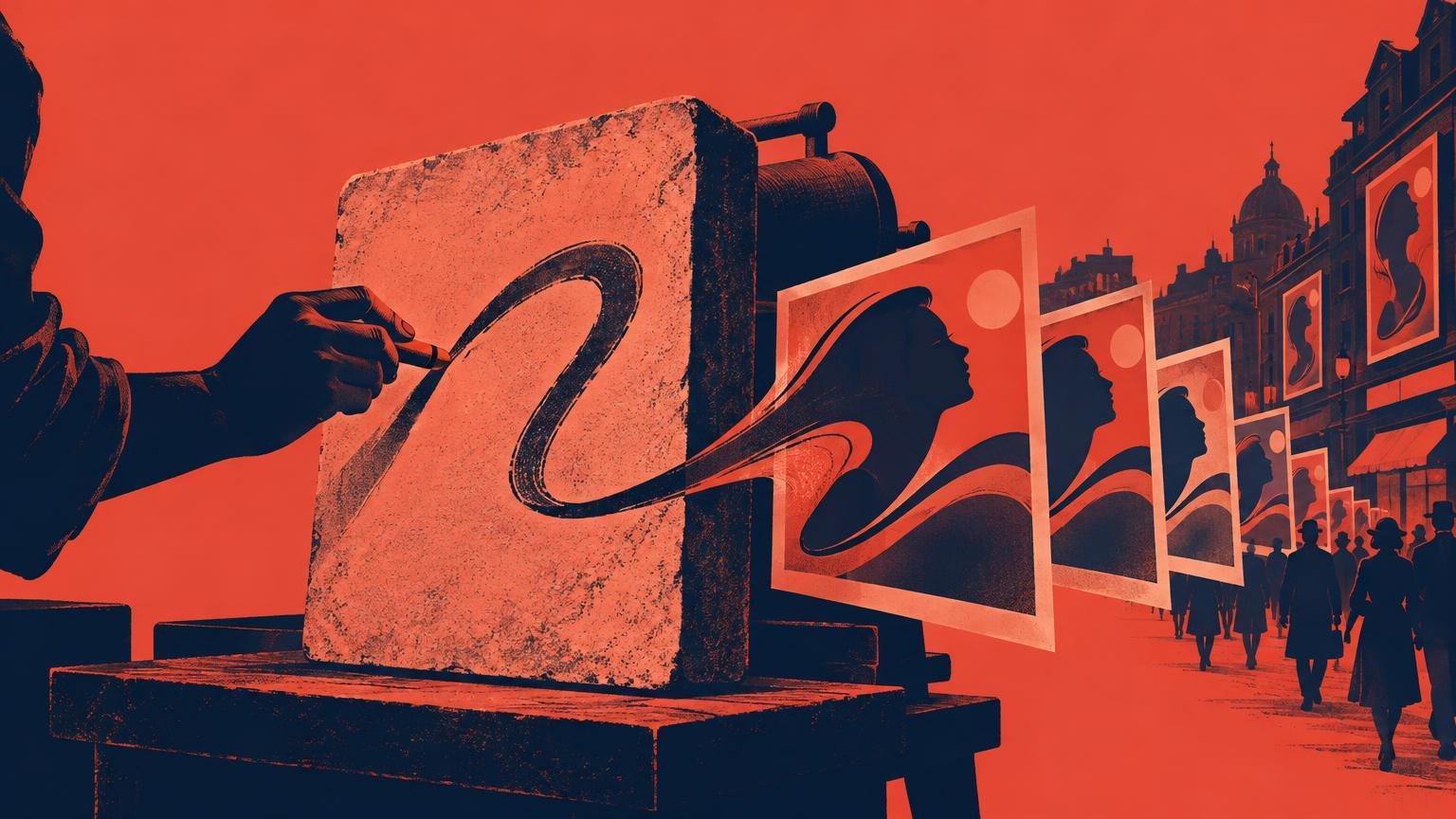
Lithography changed printing by allowing an image to begin as a drawing rather than a carving or an incision. Developed by Alois Senefelder in Bavaria in the late 1790s, the process gave artists a comparatively direct way to reproduce crayon marks, washes and broad tonal passages. It later provided commercial printers with a path from hand-drawn stones to multicolor advertising, photographic reproduction and high-speed offset presses.
The result is visible across nineteenth-century maps, illustrated reports, art prints, posters and trade advertisements—and in the offset-printed books, magazines and promotional material familiar today. The machinery changed radically, but lithography’s defining idea endured: image and nonimage areas can share one flat surface because chemistry, rather than physical height or depth, separates them.
The production problem lithography solved
Before lithography, printers generally reproduced pictures from raised woodblocks or from images engraved and etched into metal plates. Both demanded that a drawing be translated into another physical language. A woodcut required shapes to be cut around raised printing areas. Copperplate engraving required lines to be incised in reverse, inked and wiped before printing under pressure. Intaglio illustrations also commonly had to be printed separately from letterpress text and then bound into the finished publication. The Library of Congress history of mapmaking and printing shows how labor-intensive engraving constrained the production of maps in particular.
Lithography replaced this topography of raised and recessed surfaces with a planographic process. Image and blank areas occupy the same level on a chemically prepared stone. A greasy crayon or ink establishes the image; during printing, damp nonimage areas repel oily ink while the greasy drawing accepts it. Paper pressed against the inked surface receives the image.
This mattered aesthetically as much as mechanically. An artist could draw on limestone with materials that behaved more like familiar crayons and washes. The printed result could retain soft shading, broken texture and energetic strokes that were difficult to preserve when an engraver had to reinterpret every passage as a system of cut lines. Lithography did not eliminate skilled preparation, reversal or presswork, but it shortened the conceptual distance between drawing and multiple impressions.
From Senefelder’s experiment to an artist’s medium
Senefelder developed lithography around 1796 while seeking an economical way to duplicate written material, including plays and scripts. His breakthrough showed that greasy marks on suitable limestone could be repeatedly inked and printed. The Metropolitan Museum of Art’s history of nineteenth-century lithography describes the method as the century’s most direct means of producing multiples from a drawing.
Artists quickly explored what that directness could do. Théodore Géricault’s Boxers of 1818 demonstrated the weight and tonal force available from lithographic drawing. Eugène Delacroix used the process for his 1828 Faust illustrations. Later Romantic, Impressionist and Symbolist artists, including James McNeill Whistler and Edgar Degas, treated lithography as more than a reproductive shortcut: its grain, softness and tonal range became part of the image’s expression.
That shift altered the relationship between the artist and the edition. An engraving could be a skilled interpreter’s translation of another person’s design. A lithograph could preserve marks placed on the printing surface by the artist. This is why “original lithograph” has a specific historical meaning: it may describe an impression printed from a hand-drawn stone, not merely a later mechanical reproduction of an existing picture.
Lithography moved into maps, reports and public information
The process also answered a growing demand for practical images. William and John Pendleton established the first significant lithographic firm in the United States in Boston in 1825. Within two years, it was producing early New England railroad surveys and reports. For map publishers, lithography offered a less expensive alternative to engraving and helped production keep pace with expanding railroad development.
This is where the history of lithography becomes a history of information design. A railroad map was not simply an illustration. It organized routes, terrain, settlements and proposed infrastructure into a reproducible visual argument. Lithography helped institutions circulate such diagrams more widely, making the printed image an operational tool as well as an ornament.
Chromolithography turned color into an industrial sequence
Early lithographs were commonly monochrome, sometimes colored by hand. Chromolithography, developed in France in 1837, made color part of the press process. Printers prepared a separate stone for each color and printed the sheets repeatedly, keeping every layer in registration. A complex image could require between eight and forty stones.
That sequence demanded planning. The printer had to separate the intended image into colors, predict how overlapping inks would interact and align each impression closely enough to avoid colored halos around forms. The result could imitate the visual richness of watercolor or oil painting, qualities associated with many mid- and late-nineteenth-century chromolithographs in the Library of Congress collections.
Mechanization made this elaborate work more commercially practical. August Hoen’s 1869 chromolithographic press combined automatic inking, damping, feeding and delivery. Smithsonian documentation gives the press an output of 300 impressions per hour while maintaining the registration required for multicolor printing.
Color lithography created a new commercial streetscape
By the 1880s and 1890s, bright large-format lithographic posters had become a major advertising form. Henri de Toulouse-Lautrec’s four-color Moulin Rouge: La Goulue of 1891 shows how economically chosen colors, sweeping silhouettes and oversized lettering could command attention at street scale. Lithography encouraged illustrators to think in masses of color rather than only in engraved lines.
The same production logic served less celebrated commercial objects. The Hamilton Brown Shoe Company’s 1896 Largest shoe dealers in the world chromolithograph used an elaborate color image to attract customers and construct a public identity around an ordinary product. Posters and trade advertising made illustration part of daily urban life: not confined to galleries or expensive books, but pasted on walls, displayed in shops and circulated through sales networks.
Photography and offset transformed the process again
Lithography did not remain tied to drawings on stone. Photolithography was patented in 1858, while commercially used halftone photography entered magazine illustration in the 1880s. These developments allowed camera-made images and tonal originals to be converted into printable structures, expanding what publishers could reproduce.
A second decisive change arrived around 1903, when Ira W. Rubel developed a paper offset press. Instead of transferring ink directly from a plate to paper, the press transferred the image first to a rubber-covered blanket cylinder and then onto the sheet. A Rubel press from 1903 in the Smithsonian collection had a stated maximum capacity of roughly 2,500 sheets per hour. The Smithsonian’s Rubel offset press record documents the machine and its role in the transition to offset production.
The flexible blanket made reliable printing on paper more practical and helped offset lithography become a foundation of commercial production. Modern systems still distinguish ink-receptive image areas from water-receptive nonimage areas, but they typically build color from separate process-color layers composed of fine dots. This is the technical ancestry behind much of the CMYK production discussed in a modern field guide to RGB files and CMYK ink.
How to recognize lithography’s legacy
A nineteenth-century stone lithograph and a modern offset magazine are not the same kind of object. The former may preserve greasy marks drawn directly on limestone; the latter generally begins with digitally prepared files and transfers plate images through rubber blankets at industrial speed. They share a planographic, oil-and-water principle, but their image preparation, machinery and scale differ substantially.
Their family resemblance is cultural as well as chemical. Lithography established that drawings, tonal images and eventually photographs could circulate as repeatable printed matter without surrendering all their character to the engraved line. Chromolithography turned color separation and registration into a disciplined production system. Offset then made that system faster and adaptable to large print runs—a quantity decision that continues to shape publishing economics, as explained in how publishers think about print runs.
To read a lithographic object well, identify where it sits in that progression. Ask whether the image was drawn directly on stone, assembled from multiple color stones, transferred photographically to a plate or printed through an offset blanket. That distinction reveals more than a technique. It explains why the marks look the way they do, how many copies could be made, what the image cost to circulate and how lithography helped move illustration from the artist’s hand into the visual language of mass commerce.
Frequently Asked Questions
What production problem did lithography solve?
Lithography let printers reproduce pictures without translating every mark into a carved woodblock or an incised metal plate. Artists could instead draw with greasy materials on a flat printing surface, preserving more of the character of crayons, washes and tonal passages.
How does traditional stone lithography work?
The artist draws on prepared limestone with greasy crayon or ink. During printing, damp nonimage areas repel oily ink while the greasy image accepts it; both areas remain on the same flat plane.
When was lithography invented?
Alois Senefelder developed lithography in Bavaria in the late 1790s, with 1796 commonly cited. He was initially seeking an economical way to duplicate written material such as plays and scripts.
Why did artists embrace lithography?
It offered a comparatively direct route from drawing to a printed edition. Its grain and tonal range could preserve effects associated with chalk, crayon and charcoal more readily than processes that required an engraver to reinterpret the design as cut lines.
What is an original lithograph?
In its historical sense, an original lithograph can be an impression printed from a stone drawn by the artist. It is distinct from a later mechanical reproduction of an existing artwork, even if that reproduction was produced by offset lithography.
What is chromolithography?
Chromolithography is color lithography made by printing separate stones for separate colors in careful registration. Developed in France in 1837, the process could require eight to forty stones for one complex image.
How did lithography change maps and public information?
It provided a less expensive alternative to engraved maps and helped printers meet growing demand for railroad surveys and reports. William and John Pendleton’s Boston firm, established in 1825, was producing early New England railroad material within two years.
How did photography change lithographic printing?
Photolithography, patented in 1858, enabled photographic methods to help prepare printable images. Commercial halftone photography then entered magazine illustration in the 1880s, broadening the range of tonal and camera-made material publishers could reproduce.
What made offset lithography different from stone lithography?
Offset printing transfers the plate image to a rubber-covered blanket cylinder before it reaches the paper. Ira W. Rubel developed a paper offset press around 1903, helping move lithographic production toward faster commercial workflows.
How can you identify where a lithographic object fits in the process’s history?
Look at how the image was prepared and transferred: directly drawn on stone, built from registered color stones, transferred photographically to a plate or printed through an offset blanket. Those distinctions explain the object’s marks, color structure and production method.
References
- Mapmaking and Printing | History of Railroads and Maps | Articles and Essays | Railroad Maps, 1828 to 1900 | Digital Collections | Library of Congress
- Picture Processes: A Chronology – American Women: Resources from the Prints & Photographs Collections – Research Guides at Library of Congress
- Lithograph – The Metropolitan Museum of Art
- The Printed Image in the West: History and Techniques – The Metropolitan Museum of Art
- Lithography in the Nineteenth Century – The Metropolitan Museum of Art
- Nature and Antiquities: The Making of Archaeology in the Americas
- Framed chromolithograph, "Innocence," girl and lamb | Gardens
- Chromolithographs
- Patent Model for a Chromolithographic Press | National Museum of American History
- Lithographic offset press, Rubel | National Museum of American History
- The Lure of Lithography | National Postal Museum