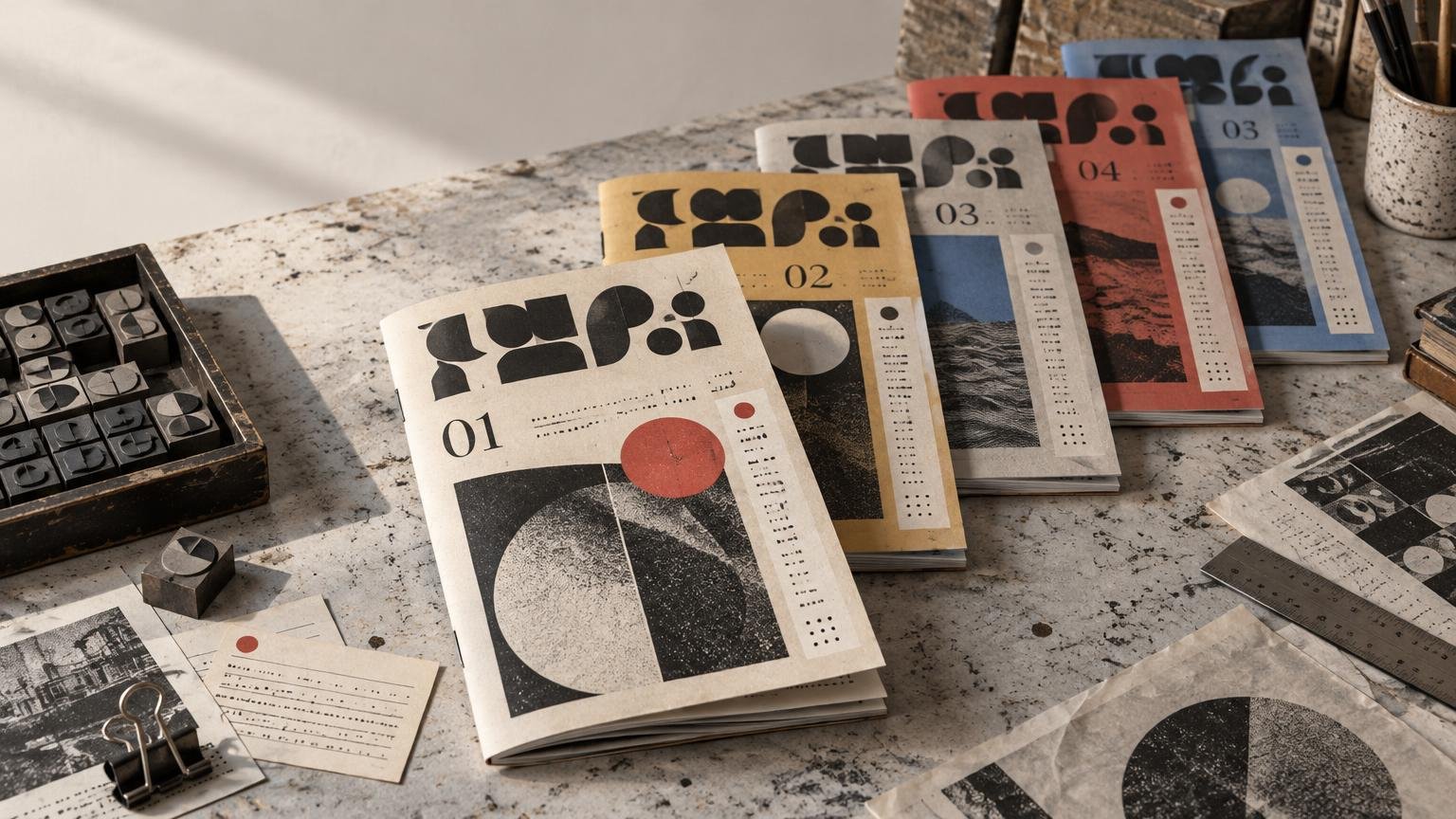
TLDR: A periodical is an ongoing publication released in separate, identifiable installments. Its issues usually carry dates, numbers, volume designations, or some combination of them, and the publisher intends the title to continue without a predetermined final installment. A magazine, journal, newsletter, recurring zine, or digital publication can qualify. Paper, binding, trim size, and visual style do not determine the category.
If you searched “what is a periodical publishing,” the useful distinction is between a publication that happens once and a publishing system built to repeat. A single magazine-shaped object may be a one-off publication. Once that title becomes a continuing sequence of dated or numbered issues, however, it begins to function as a periodical. That recurring structure affects everything from the masthead and cover to production schedules, archives, subscriptions, and identifiers.
What makes a publication a periodical?
In practical terms, a periodical passes four tests: it appears in separate issues, those issues share a continuing title, each issue can be identified within the sequence, and the sequence is intended to continue. Library and ISSN definitions place this idea within the broader category of serial publishing. A serial is issued in successive parts, generally marked with chronological or numerical designations, with no predetermined conclusion.
- Separate issues: Readers receive distinct installments rather than a single resource that is continually overwritten.
- A continuing identity: The title, editorial purpose, or recognizable publishing identity carries from one installment to the next.
- Issue-level identification: A date, issue number, volume number, season, or similar designation distinguishes each installment.
- An open-ended plan: The publisher expects further issues, even if the schedule later changes or the publication eventually closes.
None of these tests requires a glossy cover, saddle stitching, a conventional newsstand format, or even a printed object. The ISSN Manual describes periodicals as a category of serial publication and includes journals, magazines, newsletters, and blogs across print and digital media. The appearance of the object can signal periodical publishing, but its recurring issue structure is what defines it.
Periodical, serial, and continuing resource are related—not identical
Everyday publishing language is looser than library cataloging language, so several terms are often used as if they were interchangeable. They overlap, but each frames the publication differently.
| Term | Practical meaning | Typical examples |
|---|---|---|
| Periodical | A recurring publication issued as separate installments, usually on a recognizable schedule. | Magazines, journals, newsletters, recurring zines |
| Serial | The broader class of publications issued in successive designated parts with no planned conclusion. | Periodicals, newspapers, annuals, monographic series |
| Continuing resource | An umbrella category covering serials and resources updated continuously in place. | Serial publications, databases, some continuously updated websites |
| Monograph | A complete publication conceived as a finite work rather than an open-ended sequence. | A standalone book, report, catalog, or one-off zine |
| Monographic series | A sequence of individually complete books connected by a series title. | Academic book series, numbered reference volumes |
The Library of Congress lists magazines, journals, newspapers, newsletters, annuals, and monographic series as examples of serials. Its more specific cataloging guidance describes a periodical as a non-newspaper publication issued on a regular schedule in successive designated parts and intended to continue indefinitely. This is why a newspaper can clearly be a serial while being separated from “periodical” in some formal cataloging contexts.
A continuing resource is broader still. It includes conventional serials as well as integrating resources that are updated in place instead of being released as separate issues. A website whose current page is repeatedly revised may therefore be continuing without behaving like an issue-based periodical.
Publishers preparing a new serial can consult the Library of Congress presentation guidance for serial publications for practical advice about displaying titles and issue information consistently.
A magazine is a format; periodical publishing is a pattern
A magazine is usually understood through an editorial and visual format: a collection of articles, images, departments, and advertisements assembled into an issue. A periodical is defined more fundamentally by recurrence. Many magazines are periodicals, but a magazine-like object is not automatically one.
Consider an exhibition catalog designed with a masthead, cover lines, columns, and feature stories. It may look like a magazine while remaining a one-time monograph. Conversely, a modest two-color community newsletter can be a periodical if it appears as a continuing run of dated or numbered issues.
The same reasoning applies to zines. A single self-contained zine is normally a one-off publication. A zine released every season under the same title, with each installment labeled and the project intended to continue, functions as a periodical. Its small circulation, handmade binding, irregular budget, or independent editorial voice does not disqualify it.
Does a periodical need a fixed publishing frequency?
Regularity helps readers, distributors, libraries, and contributors understand the title, but “periodical” does not simply mean monthly or quarterly. A publication can be weekly, annual, seasonal, or issued on another recurring schedule. In less formal publishing contexts, an irregularly issued title may still be treated as a serial when it retains a continuing identity and designated installments.
The important editorial question is whether readers can recognize each installment as part of an ongoing sequence. “Spring 2026,” “Issue 7,” and “Volume 3, Number 1” all perform that work. An independent publisher should choose a frequency that can be sustained rather than promising a monthly rhythm and repeatedly missing it.
An annual can also qualify as a serial even though only one installment appears each year. A finite set of six planned books is different: because the sequence has a predetermined conclusion, it does not fit the standard open-ended serial definition as neatly.
How recurrence changes the design of a publication
Periodical design has two simultaneous jobs. Each issue must feel distinctive enough to be worth encountering on its own, while the complete run must remain recognizable as one publication. This tension produces many of the visual conventions associated with magazines and journals.
A repeatable masthead and cover architecture
The masthead usually remains stable enough to establish continuity. Its scale, position, color, or interaction with cover imagery may change, but readers should still be able to identify the title. A cover system also needs designated places for issue metadata, price information, feature lines, and machine-readable elements when those are part of distribution.
Consistency does not require identical covers. A rigid academic journal might preserve nearly every typographic relationship, while a cultural magazine may let artwork overlap or partially obscure its name. Both approaches can work when the underlying identity remains legible across a run.
Volume, issue, and date logic
Numbering is functional metadata and a visual device. It lets a reader request a specific installment, helps a library arrange a run, and allows an editor to refer accurately to earlier material. Publishers should decide what constitutes a volume, when numbering resets, and how dates appear before producing the first issue.
A simple quarterly might label its first year Volume 1, with issues numbered 1 through 4. The second year becomes Volume 2. Another title might use one continuous sequence—Issue 1, Issue 2, Issue 3—without volumes. Either system can work if it is applied consistently and does not create two issues with the same identity.
Recurring departments and navigational patterns
Readers learn a periodical through repetition. A contents page appears in an expected location. Reviews, letters, contributors, and back-page features develop recognizable treatments. Folios and section markers make each issue navigable, while recurring grids and type roles let the design team assemble new material without reinventing the publication every cycle.
A design system should create useful constraints, not flatten every story into the same shape. Stable body typography, margins, folios, and department openers can support more expressive feature layouts. The recurring framework carries the title’s identity while individual stories provide variation.
Production that can survive repetition
A beautiful first issue is not a successful system if its paper, page count, binding, or elaborate finishes cannot be repeated within the available time and budget. Independent publishers should test the editorial grid against short articles, long features, image-heavy pages, advertisements, and late substitutions. They should also plan proofing, corrections, file naming, and archiving as recurring operations rather than one-time tasks.
For a physical edition, settle the trim size, binding range, color plan, and realistic quantity before building every template. Print production planning should begin early enough for those constraints to inform the design. Small publishers can also compare short-run magazine printing alternatives and establish a repeatable print proofing process before committing to a release calendar.
A short history of issue-and-volume logic
Periodical numbering is not a recent administrative invention. Benjamin Franklin’s The General Magazine provides an early American example of the form. The Library of Congress record identifies a monthly run beginning with Volume 1, Number 1 in January 1741 and ending with Number 6 in June 1741. Even though its run was brief, its volume, issue, and date structure made every installment identifiable within a continuing title.
That example also clarifies an apparent contradiction: a periodical may cease after only a few issues. What matters is that it was conceived and presented as continuing, not that it succeeded in publishing forever. “No predetermined conclusion” describes the publishing plan, not a guarantee of permanence.
Does a periodical need an ISSN?
No. An International Standard Serial Number is an identifier for a continuing resource, not the feature that turns a publication into a periodical. A qualifying title can function as a periodical before it receives an ISSN, and not every informal or small-circulation title applies for one.
An ISSN helps distinguish one continuing title from another in catalogs, databases, distribution systems, and publishing workflows. It does not certify editorial quality, establish copyright ownership, or guarantee that a publication is legitimate. Publishers deciding between identifiers can use this guide to ISBNs and ISSNs for books and serial publications.
Formal presentation still matters when applying for an identifier or supplying issues to libraries. ISO 8:2019 addresses the presentation and identification of periodicals in print and dynamic digital media. In practice, a plainly displayed title, consistent issue designation, publisher information, and stable numbering system make the publication easier to identify whether or not an ISSN is involved.
Can digital magazines and blogs be periodicals?
A digital magazine can clearly function as a periodical when it releases distinct, dated or numbered issues under a continuing title. The delivery method—PDF, app, web edition, email, or print—does not erase the serial structure.
Blogs are more context-dependent. A blog that publishes individual posts into one continuously changing stream may be treated as a continuing resource, and ISSN practice can encompass blogs. From a design and reader-experience perspective, however, it does not necessarily behave like an issue-based periodical. A blog that packages posts into numbered editions, dated releases, or downloadable issues makes the periodical relationship much clearer.
A checklist for your own publication
Before calling a new title a periodical, answer these questions:
- Will it appear as separate installments rather than one complete work?
- Will every installment use the same continuing title?
- Can readers identify a particular installment by date, number, volume, season, or another clear designation?
- Is the title intended to continue without a predetermined final issue?
- Is the proposed schedule realistic for the editorial and production team?
- Does the design distinguish individual issues while preserving a recognizable identity?
- Are numbering, masthead placement, folios, contents pages, and recurring departments documented?
- Can the production method, budget, proofing routine, and archive plan be repeated?
If the first four answers are yes, the title has the essential structure of a periodical. The remaining questions determine whether that structure will be understandable and sustainable.
The defining feature is a continuing promise
A periodical is not defined by gloss paper, columns, advertisements, perfect binding, or a familiar magazine silhouette. It is an ongoing title expressed through separate, identifiable installments. Dates and issue numbers make the sequence visible; recurring typography and navigation make it usable; a repeatable production system makes it sustainable.
For a new magazine, journal, newsletter, or zine, begin by writing the sequence before styling the first cover. Decide how issues will be named, how often they can genuinely appear, which visual elements will remain stable, and how each installment will be archived. That framework is what turns an attractive publication into a periodical publishing system.